
Selfess - Daily Human Experiment
In Short
Selfess is an interactive psychological profiling system driven by moral dilemma choices. I independently handled the end-to-end process, from product concept, UIUX to full-stack frontend development, and dynamic data visualization.
Unlike conventional personality tests that rely on tedious, one-off questionnaires with static labels, the platform uses a structured loop: Day 1 cold start (3 dilemma prompts) - baseline profile generation - daily global sync prompt - continuous matrix calibration. This shifts the experience from an evaluation form into an ongoing, low-friction self-reflection tool.
Design Problem & Challenge
- Lower Cold-Start Friction: Replace mechanical Likert scales with high-stakes ethical scenarios, allowing users to unlock a high-density initial profile and crowd distribution data within just three decisions.
- Build Daily Retention: Shift to a single globally synchronized question per day from Day 2 onward, using incremental inputs to continuously refine the Big Five personality matrix and qualitative analysis over time.
Core Interaction & Information Architecture
Step 1: The Dilemma Prompt & Input Interaction
- High-Stakes Scenarios: Classic thought experiments exploring ethical trade-offs
- Press-and-Hold Confirmation:Replaced simple taps with a hold-to-confirm interaction. This introduces intentional friction, preventing misclicks and forcing users to deliberate.
- Social Mirroring:After confirming, the system displays real-time answer distributions, contextualizing the user's decision within broader collective behavior.
Step 2: Progressive Cold Start
- Three-Prompt Baseline:Users resolve three core dilemmas on Day 1 to instantly generate their baseline profile.
- Fast Feedback Loop:Delivers high-density analytical value with minimal cognitive cost.
Step 3: Daily Cadence
- From Day 2 onward, the system unlocks one question per day, synchronized globally.
- Each response logs historical choices and recalculates the personality matrix, turning the platform into a longitudinal reflection tool.
Dashboard Architecture
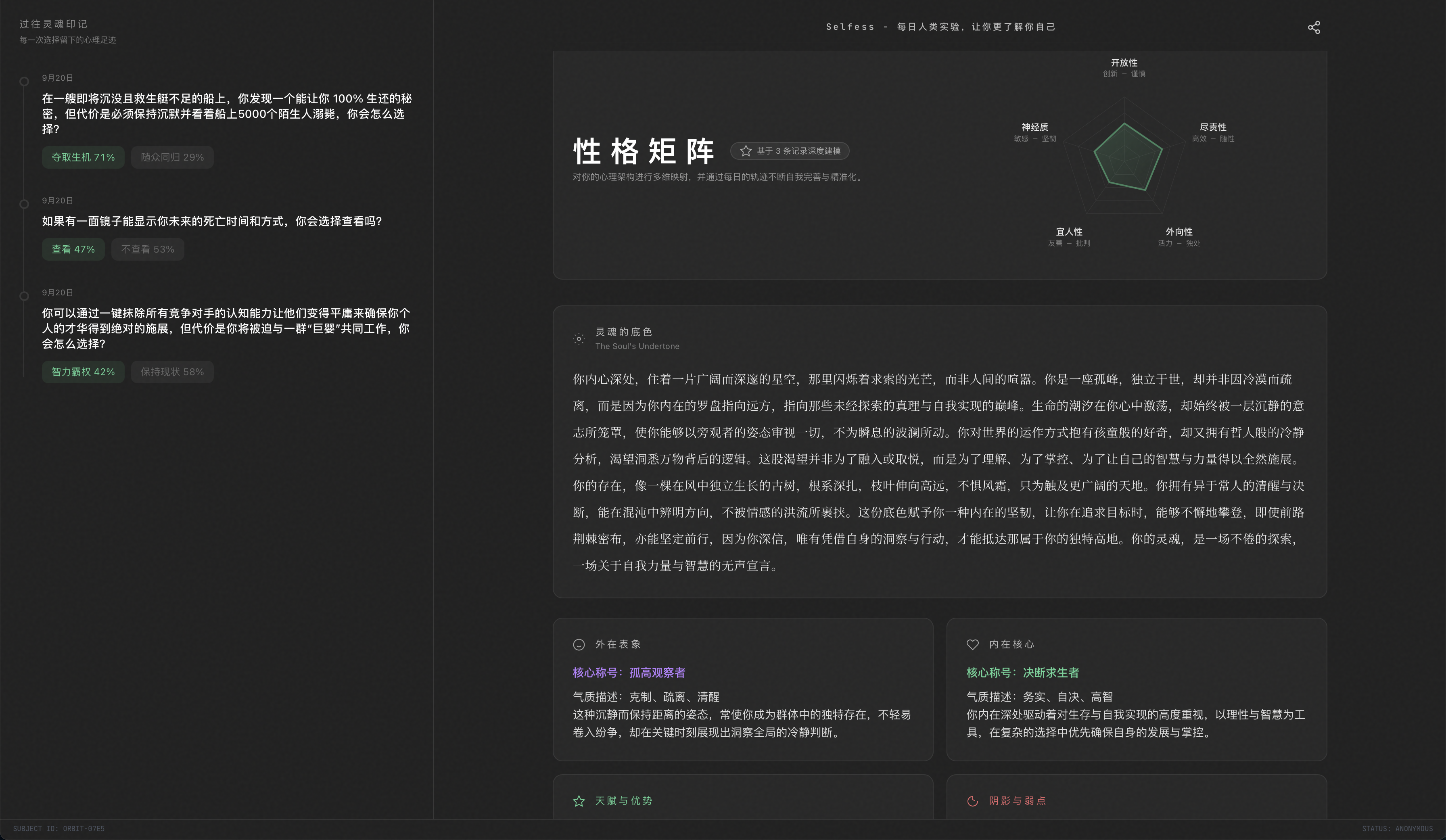
The dashboard uses a two-column layout: the left column tracks historical decisions and timeline data, while the right column displays the multi-dimensional analysis.
Left Panel
- Decision Footprints & Timeline: dilemmas alongside the user’s selection and crowd distribution, serving as a chronological audit log of their personal mindset.

Right Panel
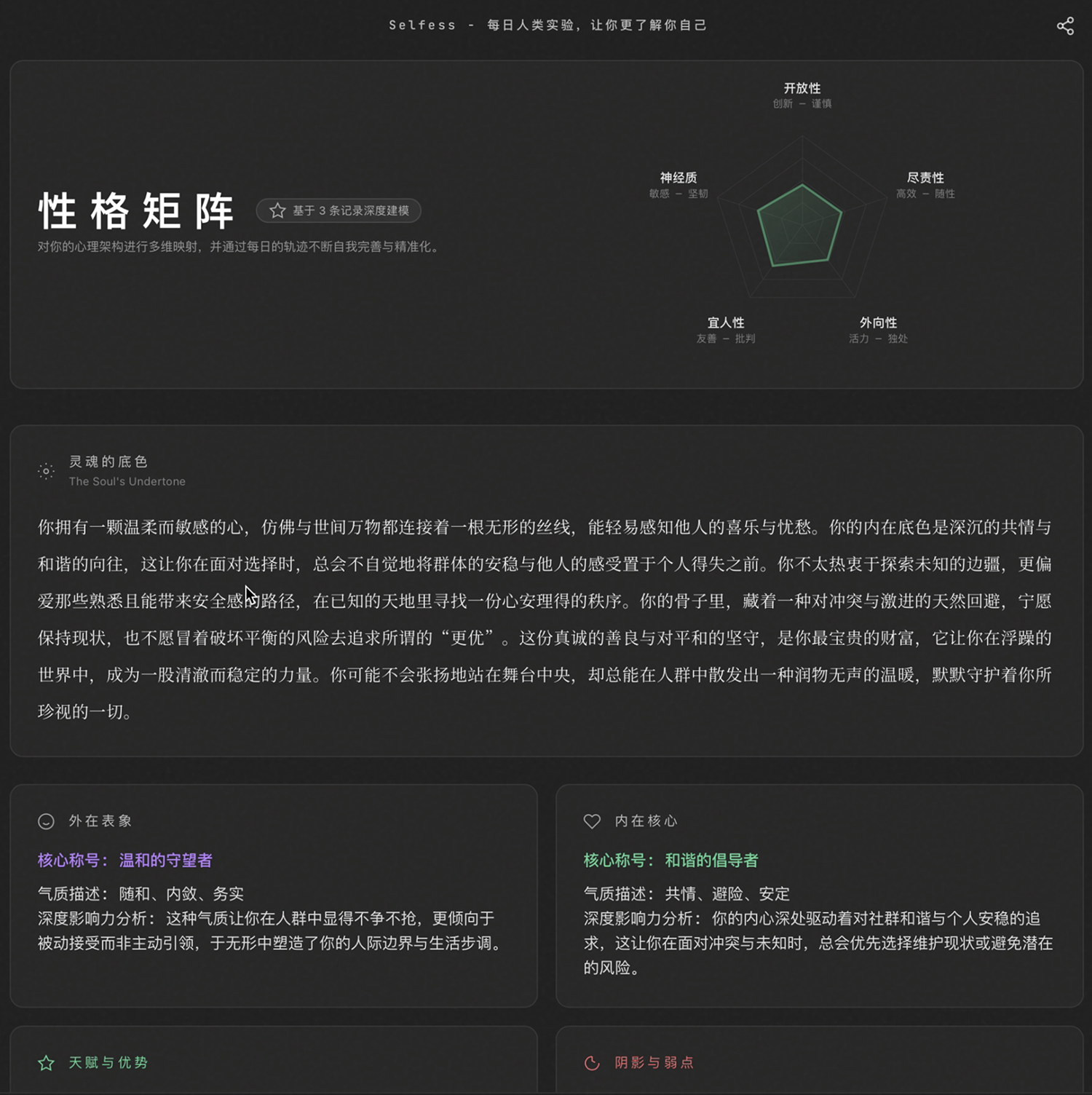
- Big Five Radar Matrix: Maps responses against standard Big Five personality dimensions displays sample confidence explicitly, communicating that the data becomes more accurate with daily answers.
- The Soul’s Undertone: Long-form qualitative breakdown focusing on internal motivations, emotional baseline, and instinctive behavioral patterns.
- Dual-Perspective Profiling: Public Facade vs. Core Self , Strengths vs. Shadows
UI Style & Design System
The UI pairs a #121212 dark canvas with #10B981 green accents, using Swiss grid card layouts and restrained micro-interactions (hold-to-confirm, dynamic radar plots) to create a focused, low-distraction reflection space.

Design Takeaways
Replaces diagnostic testing with an ongoing reflection log, delivering high-density psychological profiles from just three targeted scenario choices to eliminate questionnaire fatigue.